Showing posts with label Shelburne Blockhouse. Show all posts

Wednesday, June 14, 2023

Colonial Blockhouse

Stillwater Blockhouse Plan

 Last October, I decided to take part in the Little Wars TV Discord "Secret Soldier."  Basically, this was the group's version of a traditional Secret Santa swap, where wargamers picked names and traded gifts with each other.  I don't remember the exact parameters, but the idea was to keep the cost low, and buy/build something that your recipient would like.

28mm Colonial Blockhouse

For my gift, I decided to build a colonial blockhouse, such that may be found in New England during the French & Indian War or American Revolution.  I'd been wanting to build one anyway, being fascinated with the Battle of Shelburne Blockhouse, so I had much of the material on hand.

Early in November, I had a day to myself, so I traveled over to the Saratoga, NY area to visit the Stillwater Blockhouse, a replica that resembles what I've always pictured the Shelburne building to look like.

Stillwater Blockhouse on the Hudson River

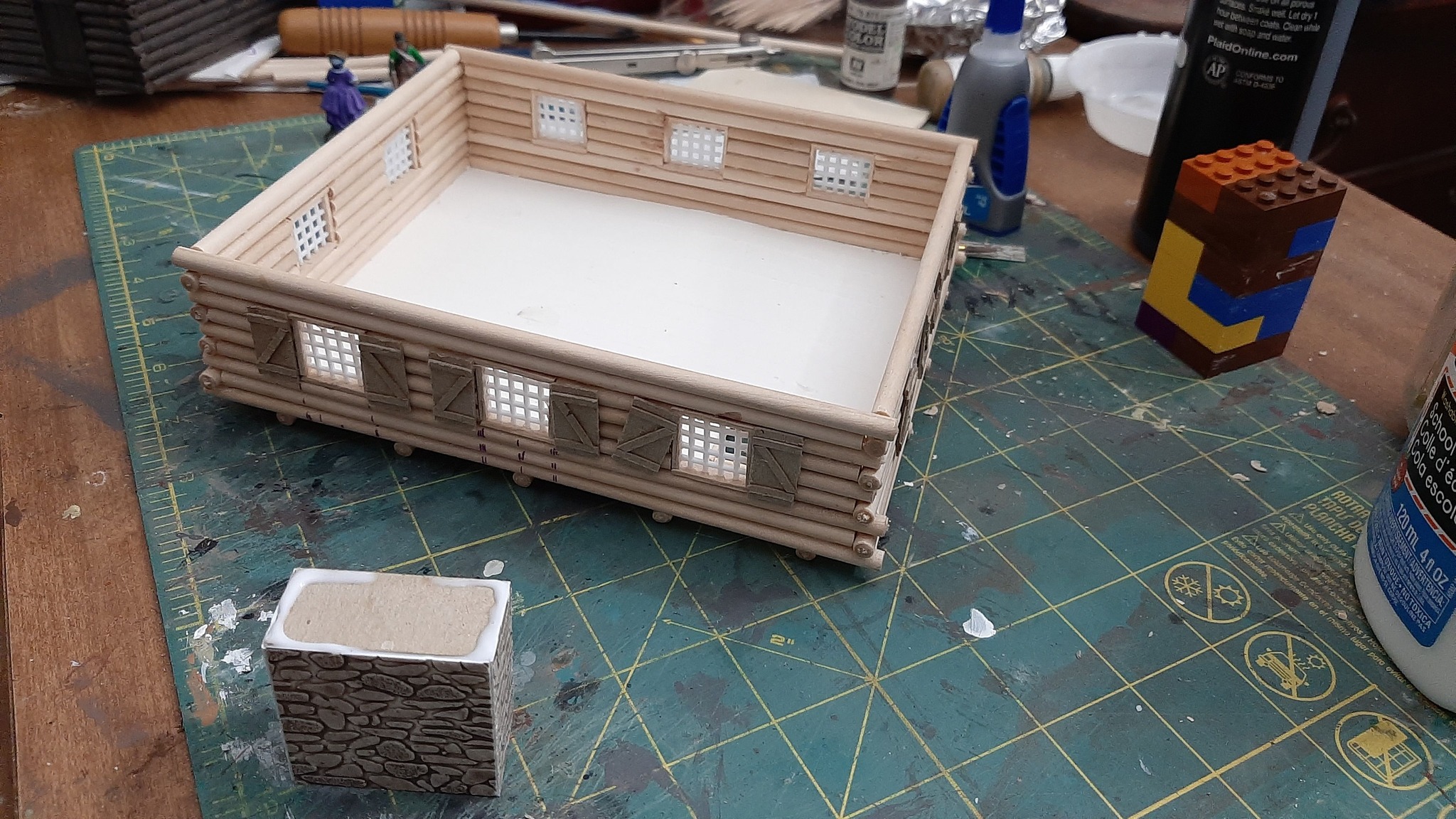
Based on photos I took there, I started building, tier by tier, with 1/4" dowels, cut to length as I went, to give a log construction look.  I was on a time crunch, so I didn't square off the dowels to get a perfect fit, but I still achieved the look I was going for.  I used a 28mm figure from Perry Miniatures Civilians pack to size the doors, windows, and ceiling heights.

First floor before stain and paint.

With the first floor finished, I stained the wood with a dark brown, then drybrushed with grey, trying to recreate the color of the Stillwater blockhouse.  I then moved onto the second floor.  Somewhere along the line I also decided to add a fireplace, made from card stock and stone patterned styrene.

First floor fireplace.

Patterned styrene was also used to represent the shingled roof.  With my deadline looming, this was the portion of the project that I rushed the most.  When all else fails, add more glue.

Second floor in progress.

Unfortunately, I missed the Christmas deadline for my recipient.  I did, however, finish the project in January and send it out to him.  Though the build was a bit tedious, adding courses one by one, I really like the look, and may build a second one for myself at some point.

Second floor complete.


Tuesday, February 26, 2019

Hyde Log Cabin

This past weekend, my girls decided that they needed to get out of the house and go on a road trip.  With snacks and activities packed for the van, we headed north and landed at the Hyde Log Cabin in Grand Isle, Vermont.

Hyde Log Cabin
It started raining just as we neared the property, then stopped just long enough for me to snap a few photos.  The building is closed during the winter, but I was able to get a few shots of the interior through the windows.

Currently run as a museum by the Grand Isle Historical Society, the cabin was built in 1783 by Jedediah Hyde, Jr.  It is the oldest standing log cabin in Vermont, and is believed to be the oldest standing log cabin within the United States.

Informational Plaque.
From an architectural perspective, the building has some odd features, though it's difficult to tell how many are changes from the original building.  There are some obvious modern touches, such as the standing seam roof and window frames.  Other unusual features are the different sizes of windows, and the fireplace back built into the wall with the chimney inside the upper wooden structure.

3/4 View of the rear and side showing at least 4 sizes of windows.

Fireplace back with chimney on the interior.
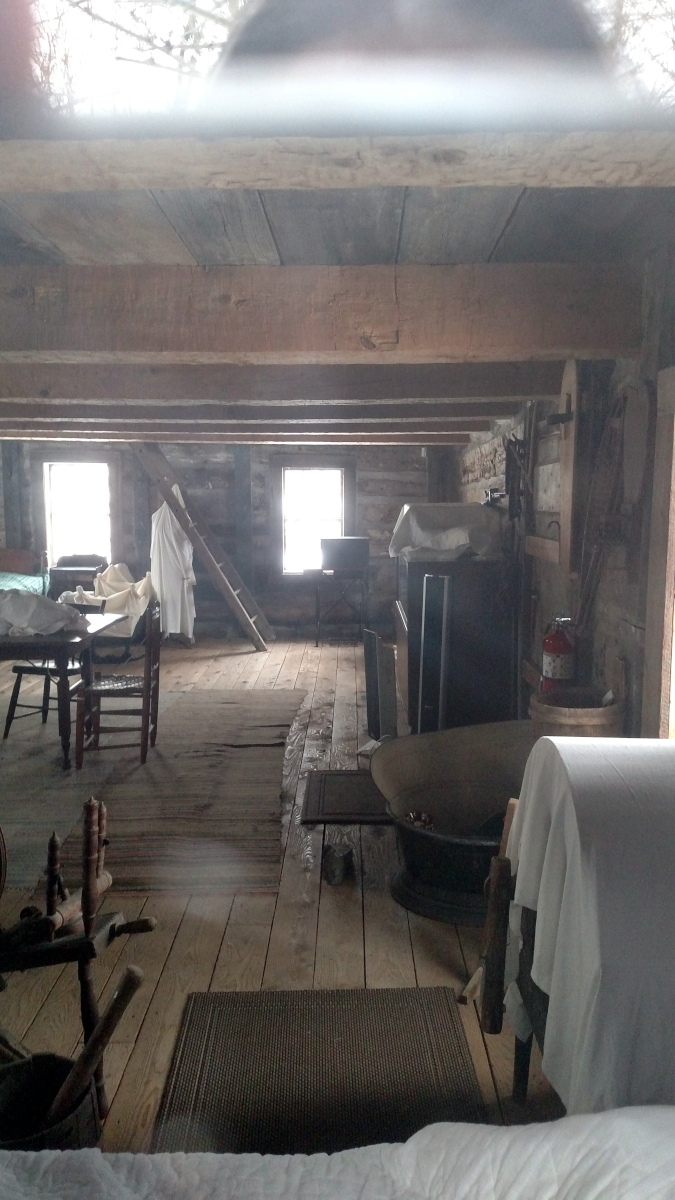
The inside of the building actually looks incredibly cozy, with one large open space on the first floor, and a ladder/stair leading to what is probably an open loft space above.
Interior through window.


Interior through window.
With its log construction and mud/daub chinking between courses, this is actually how I picture that the blockhouse of Moses Pierson may have looked, especially if it used the smaller rectangular windows like the one on the rear of the Hyde Cabin.

After a quick look around, the kids and I loaded back into the van, just in time for ice and sleet to start falling from the sky.  We may make a trip back after the building opens for visitors again in May in order to take a better look at the inside.

Detail of wall, eaves, and second floor support structure.

Detail of upper gable end.

Back rear corner with small rectangular window.

Front window next to what may have been on original window opening?

Wednesday, September 19, 2018

The Siege of Shelburne Blockhouse

On a little patch of grass, wedged between a half-sized basketball court and the entry to a short boat ramp, in a small park on an out of the way road in a little town sits a large stone embedded with a bronze plaque. Dedicated in October of 1913, the plaque tells the story of the Battle of Shelburne Blockhouse, a little known skirmish that occurred on the Vermont shore of Lake Champlain during the American Revolution.

There's a monument over there.
In 1770, a gentleman by the name of Moses Pierson (or Peirson, or Person, depending on the source document) built a house and barn on 1,000 acres of property that he had bought in Shelburne in the New Hampshire Grants. Some sources say the house was a cabin, most state it as a “blockhouse”. Mr. Pierson's house must have been a well-known stopover point, as it is mentioned in the journal of Lieutenant John Fassett, Jr. of Colonel Seth Warner's Regiment in 1775, and during the day related here, two men, described as travelers, were spending the night at the house.
Area of Moses Pierson's property - Today Shelburne Town Beach & private lands.

As the monument states, on March 12, 1778, Moses Pierson, his family, guests, and some militia from the Rutland/Clarendon area were attacked by a band of Indians and “British dressed as Indians”. The attackers came from the lake, possibly on skates or snowshoes (accounts vary) likely with a target of capturing wheat that the Piersons had harvested the season before.

Shelburne Town Beach - Location of the Moses Pierson Monument
The attack began roughly an hour before dawn. The two travelers, named Woodward and Daniels, along with Barnabas Barnum of the militia, were killed in the initial assault on the blockhouse. One account states that Barnum was shot as he looked out of a blockhouse window. Another states that he was killed outside while trying to extinguish flames as the attackers tried to set fire to the building.
Meech Island, south of the cove - Burial place of Moses Pierson's son James.
The men inside the blockhouse were able to fight off the assault, which continued for about two hours. During that time, the attackers did succeed in setting fire to the building. One story goes that Thomas Sawyer, of the militia, offered his pocket-watch to anyone who would go to extinguish the flames. Corporal Joseph Williams took him up on his offer, but finding no water, used a freshly brewed batch of Mrs. Pierson's beer to put out the fire. Another version of the story says that a Captain Sanger ordered the contents of the beer barrel to be used, and several men went outside to kill the flames. Both accounts agree, however, that the building was saved by beer.

Area northwest of the monument - General area of the Pierson Blockhouse and barn.
When the fight was over, it was found that in addition to the three dead men in the Pierson's house, several of the enemy had been killed, including the British commander and an Indian Chief. Legend has it that the enemy had dragged some of their dead to the Lake, where they tossed them in a hole in the ice.

Further west along the north side of the cove.
Being a bad researcher, I've drawn this story from several secondary sources, which, of course, I haven't noted. Being a good researcher, I'm beginning to look into primary, or at least period, accounts of the action. My youngest daughter and I also visited the monument site today, so that I can have a better picture of the landscape. Fortunately, most of the area is still farmland, so it looks much like it may have then. Unfortunately, that farmland is all private property, so we were restricted to viewing the area from the Shelburne Town Beach.

The Monument.
Reading the secondary accounts, it seems the attack was carried out by roughly 60 men (one account says 57, one says 64), and the blockhouse was defended by roughly 24, including Moses Pierson's family. In some aspects, the accounts are vague. In others, they are incredibly detailed. For instance, one source that I read mentioned that Moses himself wasn't wounded, but had taken a shot through his shirt that passed just below his arm. Accounts also state that Pierson's young daughters, who were lying on beds within the house, where not hurt, though balls from the enemy muskets were found lodged in the headboards. I look forward to researching this action more, through both contemporary and period sources.